




It's 1:00 PM, and your 2:00 PM tour has three empty seats. A family just arrived in town, they're searching for activities, and your experience is exactly what they want. But they can't book you because your cut-off time closed hours ago. Those three seats will stay empty, and that family will book a different experience instead.
This scenario plays out frequently across the travel experiences industry—and it represents a significant opportunity. Nearly half of all travelers book their experiences after they arrive at their destination, and 46.5% of leisure bookings happen within 0-3 days of the experience.
The question many operators are asking is: how can I capture last-minute demand without making my operations more complicated?
We’ve identified 6 practical strategies that help you capture last-minute demand without adding much more complexity to your day. Let's explore how to turn those empty seats into bookings.
Understanding how travelers actually book
First, let's talk about what's really happening out there. Travel booking behavior has fundamentally changed. The traditional "plan everything months ahead" traveler still exists, but they're now joined by a massive wave of spontaneous bookers.
46.5% of leisure activity bookings happen 0-3 days before the experience. That's nearly half of all bookings. 7 out of 10 frequent travelers book activities when they arrive to stay flexible. They want to see the weather, get local recommendations, and decide based on how they feel that day.
If your cut-off time is 10+ hours, you may be missing out on nearly half the market. When these travelers search for things to do today or activities tomorrow, your experience doesn't appear in results. You're not even in the consideration set.
Many operators wonder if they need to choose between accepting last-minute bookings or maintaining longer cut-off times for operational ease. But there's actually a whole spectrum of smart strategies in between. Let’s explore them.
1. Give different tours different rules
Not all departure times are created equal. Some need more preparation; others are ready to go.
Imagine you run a food tour at 9:00 AM and 4:00 PM. Your morning tour needs coordination. You need to confirm your guides the night before, prep ingredients or equipment, maybe coordinate with partners. A booking at 8:00 AM would throw everything off, if this is not a guaranteed departure.
But your afternoon tour? The guide is already there and everything is ready.
This is where variable cut-off times come in. Last Spring, we launched advanced cut-off controls* so you can set different cut-off times for different departure times. This simple change lets you protect your prep time while staying open for flexible bookings.
*Note that this feature is only available for non-connected products.
Watch our team introduce the feature:
For example, a bike tour company in Amsterdam runs tours at 10:00 AM, 1:00 PM, and 4:00 PM. Their 10:00 AM tour has a 10-hour cut-off. Their 1:00 PM tour has a 2-hour cut-off. Their 4:00 PM tour has a 30-minutes cut-off.
Why this works: The morning tour needs advance notice for guide scheduling. But by afternoon, the guide is already there, the route is set, and adding people is simple. They capture last-minute bookings without disrupting their morning operations.
How to set this up:
✓ Look at each departure time and identify which departures need more prep time
✓ Ask yourself: “What actually needs to happen if someone books X hours before?”
✓ Set longer cut-offs (6-10 hours) for complex departures
✓ Set shorter cut-offs (1-2 hours) for straightforward ones
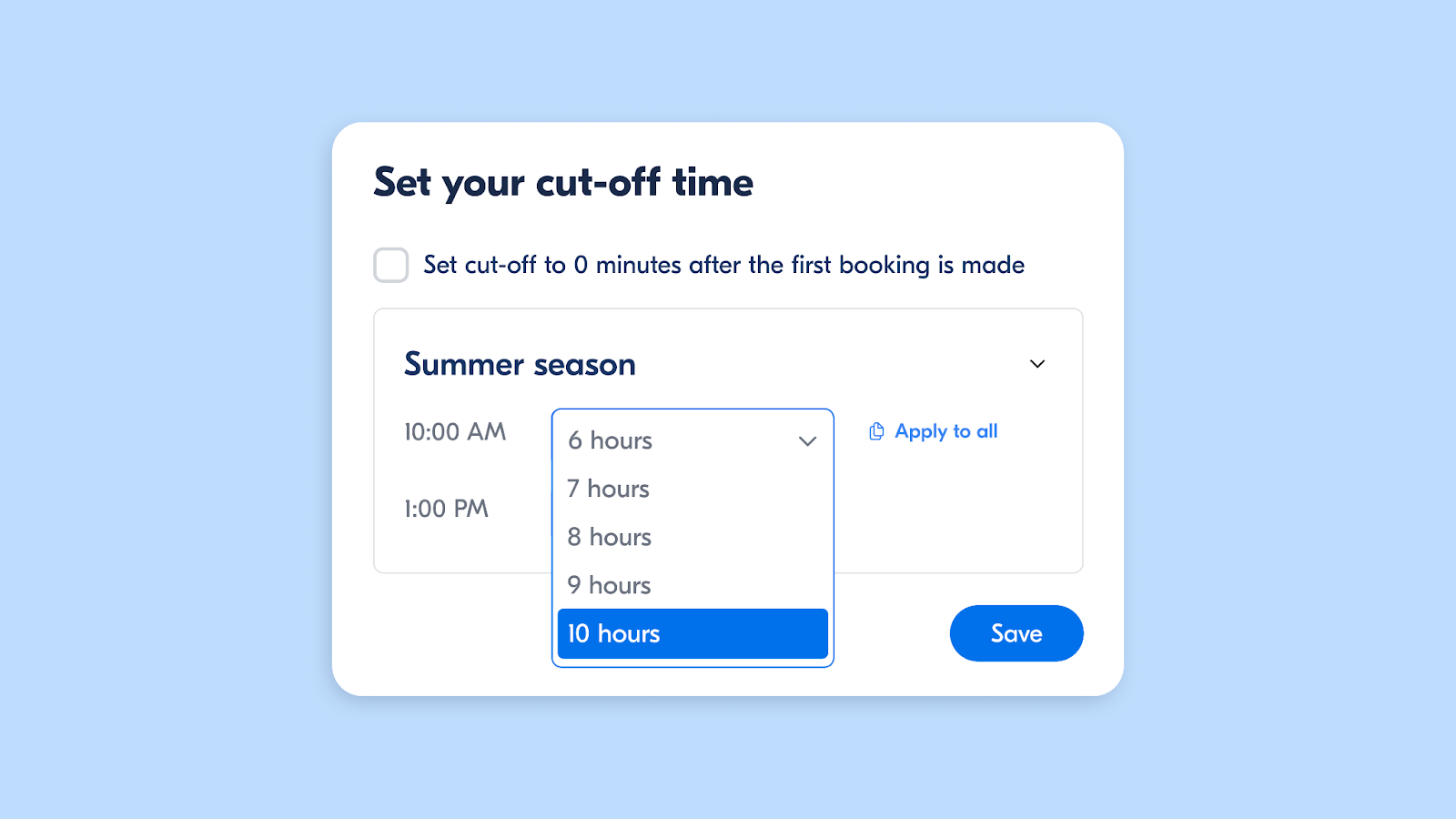
For practical details on how to set it up in the GetYourGuide Supplier Portal, check out our FAQ on variable cut-off times →
This strategy sets the foundation for everything else.
Once you understand that different tours can have different rules, you can start thinking strategically about when to be flexible and when to protect your time. Which brings us to our next strategy...
2. Let the first booking open the floodgates
Once someone books your 4:00 PM tour at 1:00 PM, you know for certain it's running. The guide is assigned, everything's confirmed, everything's locked in. At that point, why not fill the remaining seats?
This is where the zero-minute cut-off feature becomes powerful. This tool removes risk while maximizing opportunity. Here’s how it works:
- You set a default cut-off (let's say 3 hours)
- When the first person books a specific time slot, the system knows the tour is definitely running, you have a guide assigned and everything is ready to go.
- The cut-off automatically changes to 0 minutes.
- Now other travelers can book that same 2:00 PM tour at 1:00 PM, 1:30 PM or even right up until the tour starts.
Why this is brilliant: You're not taking any additional risk. You were already running the tour anyway. You're just filling seats that would otherwise stay empty. And travelers who decide last-minute can still join.
How to enable it: When you're setting up your cut-off times, look for the option "Enable last-minute bookings after the first booking". Check this box, and the system handles the rest automatically.
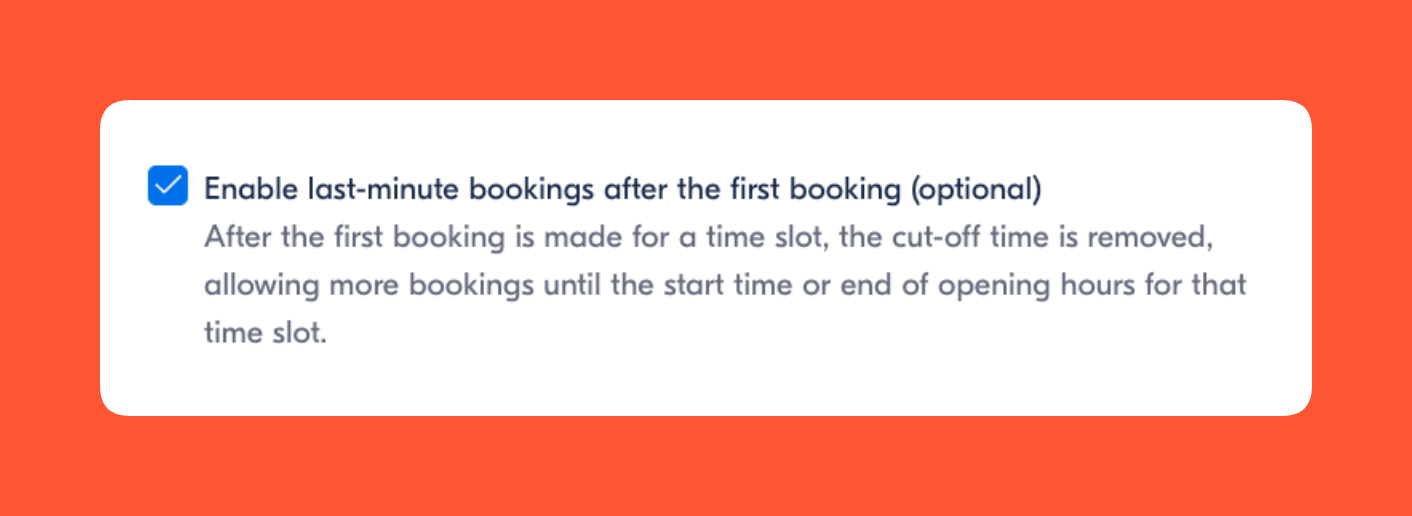
Important note: This only applies once you have at least one confirmed booking. If no one has booked yet, your default cut-off time still applies.
It is best for:
✓ Group tours where adding people doesn't change your operations
✓ Activities where you're already committed to running the departure
✓ Experiences with flexible capacity
✓ Filling seats during slower periods
Now that you understand the two core tools (variable cut-offs and zero-minute cut-off), let's talk about how to actually implement them without overwhelming yourself.
3. Start small, build confidence
You don't need to change everything overnight. In fact, you shouldn't.
Imagine picking just one tour, the one you feel most confident about, and testing there first. Not your most complex activity. Not the one that requires the most coordination, but your most straightforward, flexible activity.
The strategy is simple: test with your most flexible activity, then expand.
If you're considering reducing your cut-off time, here's a sensible way to approach it:
Step 1: Choose your test case
Pick the activity where you feel most comfortable with shorter notice. Look for activities where adding people doesn't change your operations much. That will be much easier to start with.
Step 2: Reduce gradually
Reduce the cut-off time for just that activity and start conservative. For exemple, if you're at 10 hours, try 6 hours first.
Step 3: Monitor what happens
Give it a few weeks. Are you getting more bookings? Can you handle them comfortably? Is your team stressed or is it working smoothly?
Step 4: Adjust and expand based on reality
If it's working well, consider reducing further or applying it to other activities. If it's causing problems, it's okay to increase it again or make some adjustments. You're in control. Build your confidence gradually.
Step 5: Use the “after first booking” feature strategically
Once you're comfortable with your new cut-off times, enable the zero-minute cut-off after first booking feature. This is a smart middle ground; you know the tour is running, so filling remaining seats becomes lower risk.
4. Use your slow times strategically
The zero-minute cut-off feature is especially impactful during slower periods.
When demand is high, your tours fill up anyway. But during shoulder season or mid-week lulls, last-minute bookings become critical. This is where smart cut-off management can make or break your revenue.
Be more aggressive with short cut-offs during slow periods.
- High season: You might keep slightly longer cut-offs (you'll fill up anyway)
- Shoulder season: Reduce cut-offs to capture every possible booking
- Low season: Use the zero-minute cut-off feature aggressively
Practical tip: You can adjust cut-off times anytime. If you know next week is typically slow, log in and reduce your cut-offs for those specific dates. If you know a holiday weekend will be busy, you can keep them longer.
Example: A wine tour operator in Tuscany noticed their Wednesday tours were consistently running with empty seats. They reduce the Wednesday cut-off to 2 hours and enable zero-minute bookings after the first guest to maximize sales.
5. Build systems that make it easy
Flexible cut-offs only work if you have the right systems in place to support them. For this, you need a few basic practices.
For example, here are a few key points that make all the difference:
✓ Check your bookings at regular intervals (every 2-3 hours during the day)
✓ Have pre-written messages ready for common situations (such as a quick confirmation message you can send immediately or a “here’s what you need to know” message with meeting point details)
✓ Make sure your guides know you're accepting shorter-notice bookings and create a simple way to communicate new bookings to your team
✓ Have a checklist for what needs to happen when a booking comes in
✓ Keep everything ready to go: This is the simplest but most important practice: don't wait until you get a booking to prepare. Keep your equipment accessible, your supplies stocked, and your materials organized.
These systems should help you remove friction and be more efficient when handling last-minute bookings.
6. Use the data to get better
Once you start experimenting with cut-off times, you also start seeing patterns you might have not noticed before.
The operators who get the most out of flexible cut-off times pay attention, learn from what's happening, and continuously refine their approach.
What to track (and why it matters):
- What time of day do most last-minute bookings come in?
You might discover that 80% of your same-day bookings happen between 10:00 AM and 2:00 PM. This means you can focus your attention during those hours and relax a bit outside that window.
- Which activities are getting the most last-minute interest?
Some experiences naturally attract spontaneous bookers more than others. Your sunset tour might get tons of same-day bookings, while your early morning tour doesn't. Use this insight to set different strategies for different products.
- Are there patterns by day of week or season?
You might find that Wednesdays are slow but Saturdays fill up regardless of cut-off time. Or that shoulder season needs aggressive last-minute availability while high season doesn't.
How to use this information:
- Double down on what's working: If your 4:00 PM tour consistently fills up with last-minute bookings, consider adding a 5:30 PM departure with the same short cut-off. You've found a winning formula; replicate it and expand it further to boost your sales.
- Identify which activities have the most last-minute demand: Focus your zero-minute cut-off strategy on these high-demand activities. Let the data tell you where to be aggressive and where to be conservative.
- Optimize your schedule based on actual booking patterns: If you notice most last-minute bookings happen for afternoon tours, you might add more afternoon departures and fewer morning ones. Let customer behavior guide your capacity planning.
Real example: An operator who made it work
Puchong Nakchatree, founder of Bangkok-based BigCountry Experience, didn't reduce his cut-off times to zero overnight. It was a gradual process built on trust and operational readiness.
Today, their wildly popular floating market tour has a 30-minute to 1 hour cut-off. But this success came from careful planning and systems building.
Here's what Puchong learned:
"A lot of tourists want to make last-minute bookings," he explains. "Before they arrive, they book their flights and then they book their accommodation. But tours are usually booked once they're here at the destination. That's why we've moved to shorter cutoff times for more of our products. Now they can show up even a few minutes before the tour and still book it."
The tour now appears as "sold out" half as often as it did before. This single change helped them capture bookings they were previously missing.
The key insight from Puchong's experience: "Reduce cutoff times to zero for any product you know can cope with it." They didn't do this for every activity. They identified which experiences could handle it and built the operational systems to support it.
Since implementing these strategies, BigCountry Experience has grown 10x over seven years.
Recommended read: Working in Partnership With an OTA: Spotlight on Bigcountry Experience
How to change your cut-off time
If you've decided to try a shorter cut-off, here's how to do it:
Step 1: Log into your Supplier Portal
Step 2: Go to your product and click "Edit product" → Options
Step 3: Click "Edit option" → Cut-off
Step 4: Update to your chosen time and save
Important note: If you use a reservation system like Bokun, Ventrata, or FareHarbor, you need to update the cut-off time there too. The reservation system settings override what you set in the Supplier Portal, so changing it in only one place won't work.
Learn more: Setting up cut-off times for your product
If short cut-offs genuinely don't work for you…
Some experiences truly need more preparation time. If you’ve tested shorter cut-offs and they’re creating genuine operational problems, here are other ways to capture more bookings:
Offer more departure times
Instead of one tour per day, add a second departure. This gives travelers more options without requiring shorter notice. For example, If you run a morning tour at 9:00 AM, add an afternoon departure at 2:00 PM. Travelers who miss the morning booking window can still book the afternoon tour.
Create a "quick book" version of your experience
Maybe your full tour needs advance notice, but you could offer a shorter, condensed version that's easier to prepare on short notice.
For example, a cooking class operator offers their full 3-hour "market to table" experience with a 10-hour cut-off (they need time to coordinate with the market). But they also offer a 90-minute "cooking essentials" class with a 2-hour cut-off that uses pre-purchased ingredients.
Optimize your listing to drive advance bookings
If your business model works better with advance bookings, focus on making your experience so compelling that people book it early in their planning process. This means optimizing your listing to stand out with high quality content and best-in-class configuration.
Recommended read: The Essential Guide to Launching Your Activity on GetYourGuide
Use special offers and pricing strategies to encourage advance bookings
Offer small discounts for advance bookings to encourage people to plan ahead, or different price points for last-minute bookings if you can accommodate them. This incentivizes travelers to book early while stil allowing you to charge full price for last-minute bookings if you do accept them.
The takeaway
If you're curious whether short cut-offs could work for you, we encourage you to test them on a small scale. Many operators are surprised to find it's more manageable than expected—and the revenue impact can be significant.
The data shows a clear opportunity: with a cut-off of 10+ hours, you may not appear in searches for nearly half of travelers looking to book within 0-3 days.
Our recommendation: Consider testing it for two weeks on one activity that feels manageable. If it doesn't work for your operations, you can easily adjust. But if it does work, you may discover a new revenue stream you didn't know was possible.
Ready to make the change? Update your cut-off time today